
Private Aviation for Media Productions in Costa Rica

A call sheet can look achievable in Los Angeles and become impossible the moment a crew lands in Costa Rica. A sunrise sequence on the Pacific, an executive interview in San José, and a rainforest location near Arenal may be separated by hours of ground travel, changing road conditions, and limited daylight. Private aviation for media productions turns that geography into a workable production schedule, provided the aircraft, crew, permits, and safety plan are selected for the assignment.
For producers, the value is not simply arriving in a private aircraft. It is the ability to coordinate people, equipment, locations, and weather windows with greater control. In a country where coastlines, mountains, forests, and cities can all be part of the same shoot, aviation can protect the time and creative opportunities that are most difficult to replace.
Why Private Aviation for Media Productions Changes the Schedule
Costa Rica offers exceptional visual range within a relatively compact territory, but travel time is rarely measured by distance alone. Mountain roads, seasonal rain, traffic around the Central Valley, and access to remote lodges or coastal properties can all affect a production day. A flight plan designed around the shoot allows a crew to move directly between suitable airports, airstrips, or approved landing locations rather than structuring the entire day around road transfers.
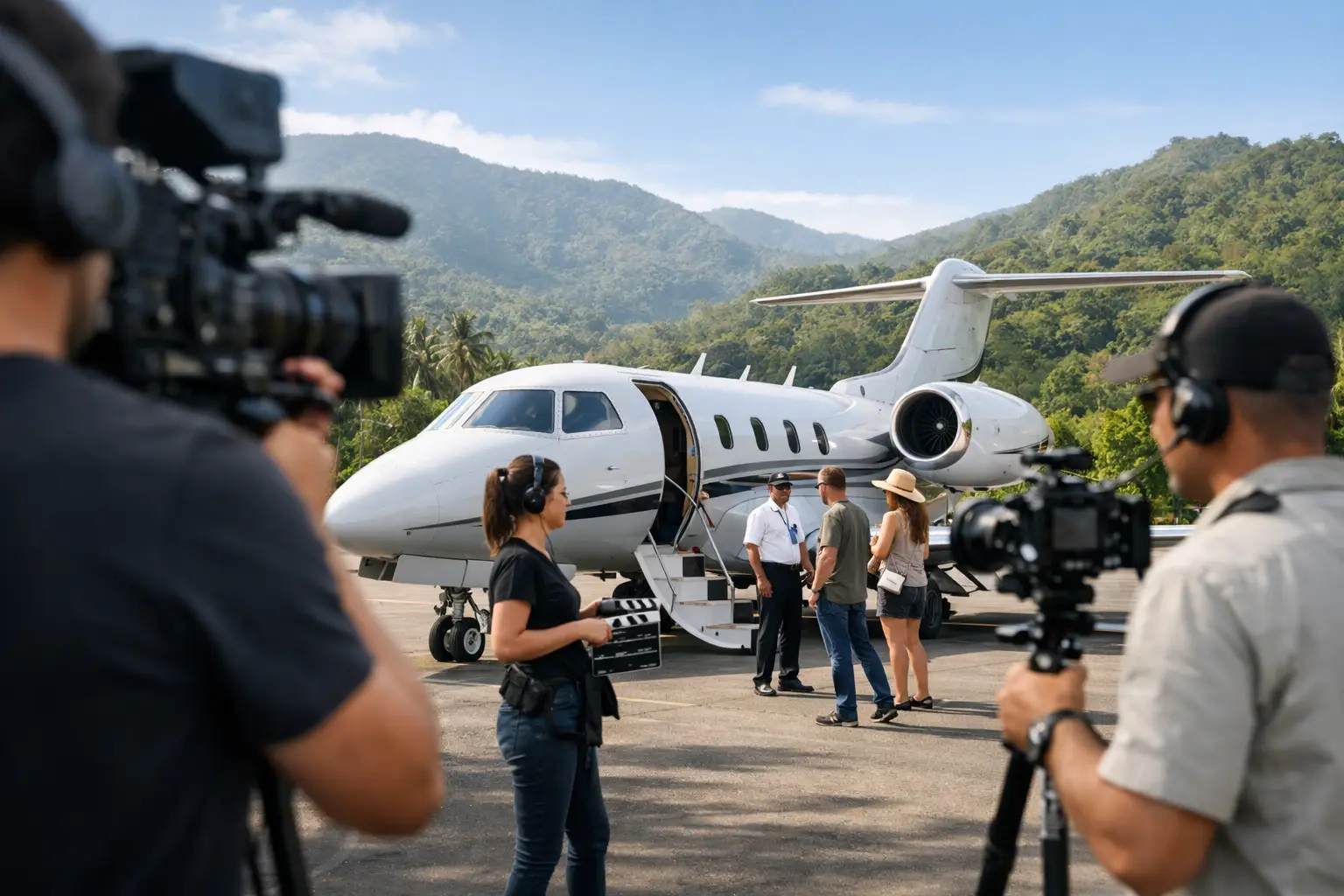
This matters most when a production has a narrow natural-light window. A commercial team may need talent at a beachfront location before first light. A documentary crew may need to reach a conservation site while animal activity is highest. A corporate production may need an executive in San José for a morning meeting and at a resort location for an afternoon interview. In each case, the aircraft supports the schedule rather than forcing the schedule to fit commercial airline routes or long drives.
Private charter also provides practical control over the passenger manifest and baggage plan. Producers can fly a small decision-making group ahead for a location scout, move key talent separately from a larger unit, or position essential crew and lightweight equipment without waiting for commercial connections. The right aircraft depends on the payload, route, runway conditions, and timing. A helicopter may be the best choice for point-to-point access and aerial work, while a private airplane can be more efficient for longer regional transfers or moving a larger group between established airports.
Aerial Filming Is an Aviation Operation First
Beautiful aerial footage is the visible result. Behind it is a specialized operation that must account for aircraft configuration, camera requirements, weather, airspace, location restrictions, and crew coordination.
Aerial filming should begin with a clear creative brief. The aviation team needs to understand whether the objective is a high, scenic establishing shot, a low-level tracking sequence where permitted, a stabilized exterior view, an open-door filming setup, or transportation to a remote ground unit. These are not interchangeable requests. Each may require different aircraft capabilities, safety procedures, camera mounting arrangements, and operational approvals.
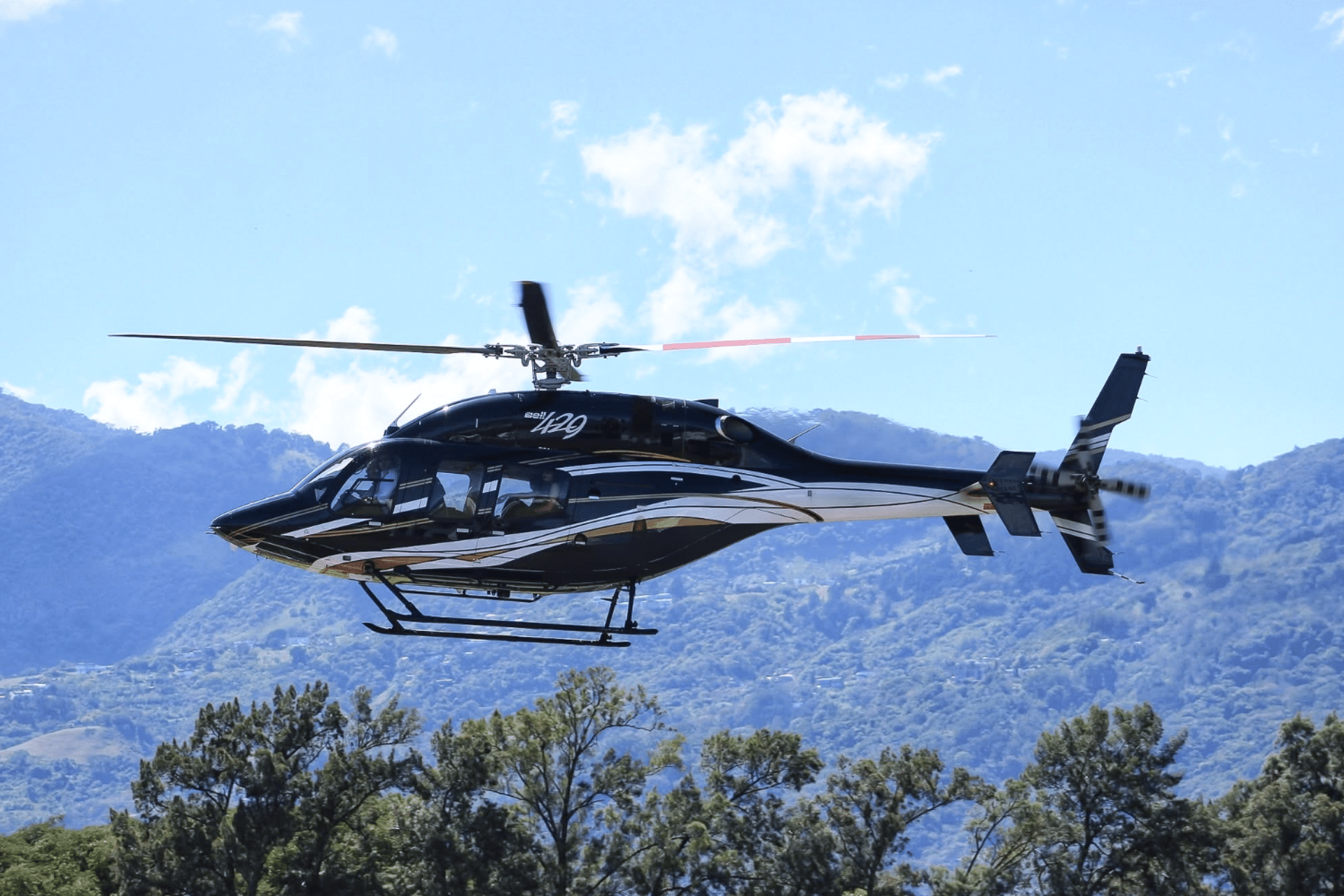
Helicopters are often valuable for productions because they can provide direct access to varied terrain and offer a dynamic aerial perspective. Yet their usefulness is shaped by real-world limits. Wind, cloud cover, visibility, weight and balance requirements, fuel planning, and local operating restrictions all influence what can be flown safely on a given day. A production plan that leaves room for weather holds and alternate shot windows is usually more effective than one that assumes every scene can be completed on the first pass.
The pilot remains responsible for the safe conduct of the flight. That means creative direction must operate within the aircraft’s approved capabilities and applicable aviation regulations. Experienced production teams treat this as an advantage, not an obstacle. A preflight discussion among the producer, director of photography, pilot, and aerial coordinator creates shared expectations about flight paths, communication, camera movement, cabin procedures, and the point at which a shot should be discontinued.
Choosing the Right Aircraft for the Assignment
The most suitable aircraft is not always the largest or fastest option. It is the aircraft that fits the mission. Passenger count, equipment dimensions, location elevation, expected weather, airport infrastructure, and the need for aerial camera work all influence that decision.
For a lean commercial shoot, a helicopter may carry a director, camera operator, and essential production personnel while providing efficient movement between locations. For a larger crew transfer, a private airplane can offer a more practical cabin and baggage solution. For projects that combine executive transport, scenic footage, and technical aerial photography, the plan may involve more than one aircraft type or a staged operation from different bases.
A qualified operator will also assess whether camera equipment can be carried and used as intended without affecting safety or aircraft performance. Producers should avoid treating aerial equipment as an afterthought. A heavy cinema package, specialty mount, or additional crew member can change payload calculations and may require a different operating approach.
Building a Production Flight Plan That Holds Up
The strongest aviation plans are developed before the final call sheet is locked. Early coordination gives the operator time to review route feasibility, identify appropriate departure points, consider fueling needs, and advise on seasonal weather patterns. It also helps the production distinguish between a location that looks ideal on a map and one that can be safely supported by air.
Start with the non-negotiables: required locations, talent availability, filming windows, passenger count, equipment list, and preferred dates. Then identify where flexibility exists. Can the aerial unit fly a day earlier if weather conditions are stronger? Can an interior interview be scheduled as a backup while low clouds delay a mountain sequence? Can key personnel be positioned near the next day’s location to protect an early start?
This planning process is especially useful for international crews unfamiliar with Costa Rica’s operating environment. Local aviation knowledge can help producers anticipate changes in weather between the Central Valley, the Caribbean slope, and the Pacific coast. It can also clarify realistic transfer times and appropriate airport or heliport options before ground logistics are committed.
Permits and permissions should be addressed early as well. Depending on the project, filming may involve property access, protected areas, municipal requirements, airspace coordination, or client security protocols. Aviation support is one part of a larger production framework. It works best when the operator is brought into the conversation alongside the location manager, production manager, and legal or permitting team.
Safety, Privacy, and Professional Conduct on Set
For premium productions, privacy is frequently as important as speed. A private flight can provide controlled movement for talent, executives, confidential client teams, and unreleased equipment. It reduces exposure at crowded terminals and allows travel details to be managed with a smaller, known group of people.
Safety remains the foundation of that discretion and efficiency. Producers should work with an operator that maintains appropriate aviation certification, follows recognized operating standards, and has experience coordinating flights for professional clients. Questions about pilot qualifications, maintenance practices, insurance, aircraft limitations, and emergency procedures are reasonable parts of the planning process. They are signs of a production team doing its job well.
On shoot day, a disciplined briefing makes a measurable difference. Crew members should understand boarding procedures, loose-item restrictions, headset communication, seatbelt requirements, safe approach areas, and how equipment will be handled. For helicopter operations, rotor safety and loading discipline are essential. No shot, however valuable, should create pressure to bypass established procedures.
Aerotour brings operating experience dating to 1973, DGAC certification, and a two-base presence in San José and Liberia to assignments that require both polished client service and practical flight coordination. For a production team, that combination can be particularly valuable when the itinerary spans Costa Rica’s principal business and tourism regions.
The Best Use of Air Time Is Planned, Not Improvised
Private aviation can make a complex media production more responsive, but it does not eliminate the need for careful preparation. It gives the team better options when a schedule changes, weather shifts, or a location proves harder to reach than expected. The return comes from using those options deliberately.
When aviation is integrated into the production plan early, it becomes more than premium transportation. It becomes a way to place the right people, in the right light, at the right location, with the operational confidence to focus on the work in front of the camera.