
How Aerial Filming Flights Operate Safely

Aerial footage can make a coastline feel endless, reveal the scale of a rainforest canopy, or give a production its defining transition in a single pass. But the shot seen on screen is only the visible result of a tightly managed aviation operation. Understanding how aerial filming flights operate helps producers, agencies, and location managers plan with the right expectations for timing, budget, safety, and creative flexibility.
In Costa Rica, a successful aerial filming mission often combines changing weather, complex terrain, protected areas, remote locations, and high production standards. The best results come from treating the flight as both a creative assignment and an aviation mission from the first briefing onward.
How aerial filming flights operate from brief to landing
Every mission starts with a conversation about the intended images, not simply a requested flight time. The production team and aerial operator define what must be filmed, where it will be filmed, the direction of travel, the desired time of day, the required camera platform, and the number of takes likely to be needed.
A useful brief identifies the subject and its movement. Is the aircraft following a vehicle on a coastal road, orbiting a resort, tracking surfers, establishing a volcano or approaching a private property? These scenarios require different flight profiles. A smooth forward-moving tracking shot has different aircraft positioning, speed, and communication needs than a wide orbit around a stationary subject.
The operator then reviews practical limitations. These include available landing sites or airports, airspace requirements, terrain elevation, weather patterns, fuel planning, aircraft performance, and any restrictions around the proposed location. In a country with mountains, rainforest, shorelines, and frequent microclimates, a plan that appears straightforward on a map may need significant adjustment once operational conditions are assessed.
The pilot retains final authority over the safe conduct of the flight. That principle protects everyone involved: the flight crew, camera team, people on the ground, the aircraft, and the production schedule. Creative goals guide the mission, but they do not override safe operating margins or regulatory requirements.
Matching the aircraft to the shot
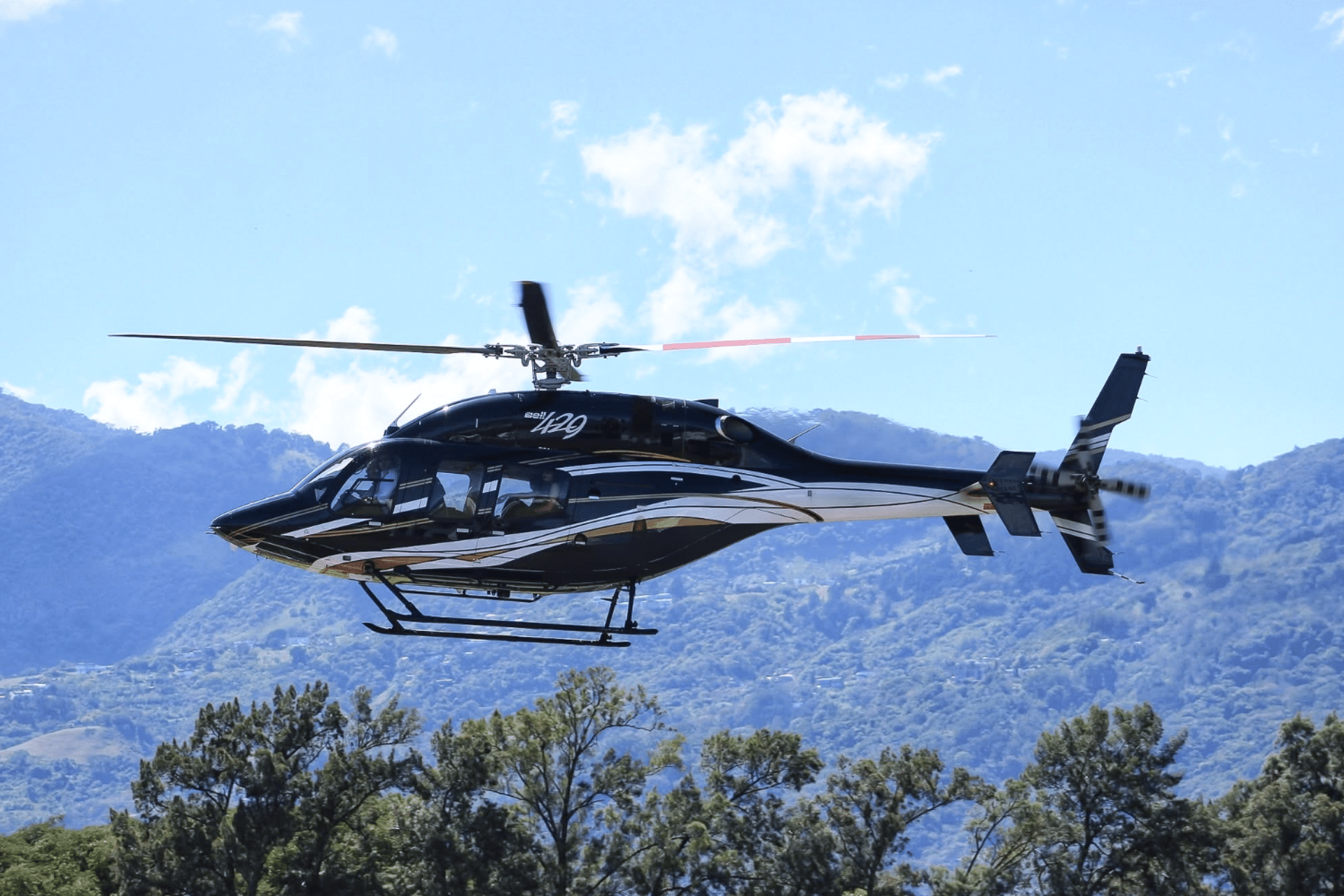
Aircraft selection is one of the most consequential early decisions. Helicopters are often the preferred platform for low-level, close-proximity, or highly responsive work because they can hover, reposition quickly, and fly profiles that suit dynamic tracking shots. They are particularly effective for filming landscapes, architecture, tourism experiences, action sequences, and subjects moving through areas with limited road access.
Fixed-wing aircraft can be an excellent option for wider landscapes, longer-distance flight paths, and projects that benefit from endurance and efficiency. Their higher operating speeds and flight characteristics may be better suited to broad establishing imagery, regional surveys, or footage where the camera does not need to remain close to the subject.
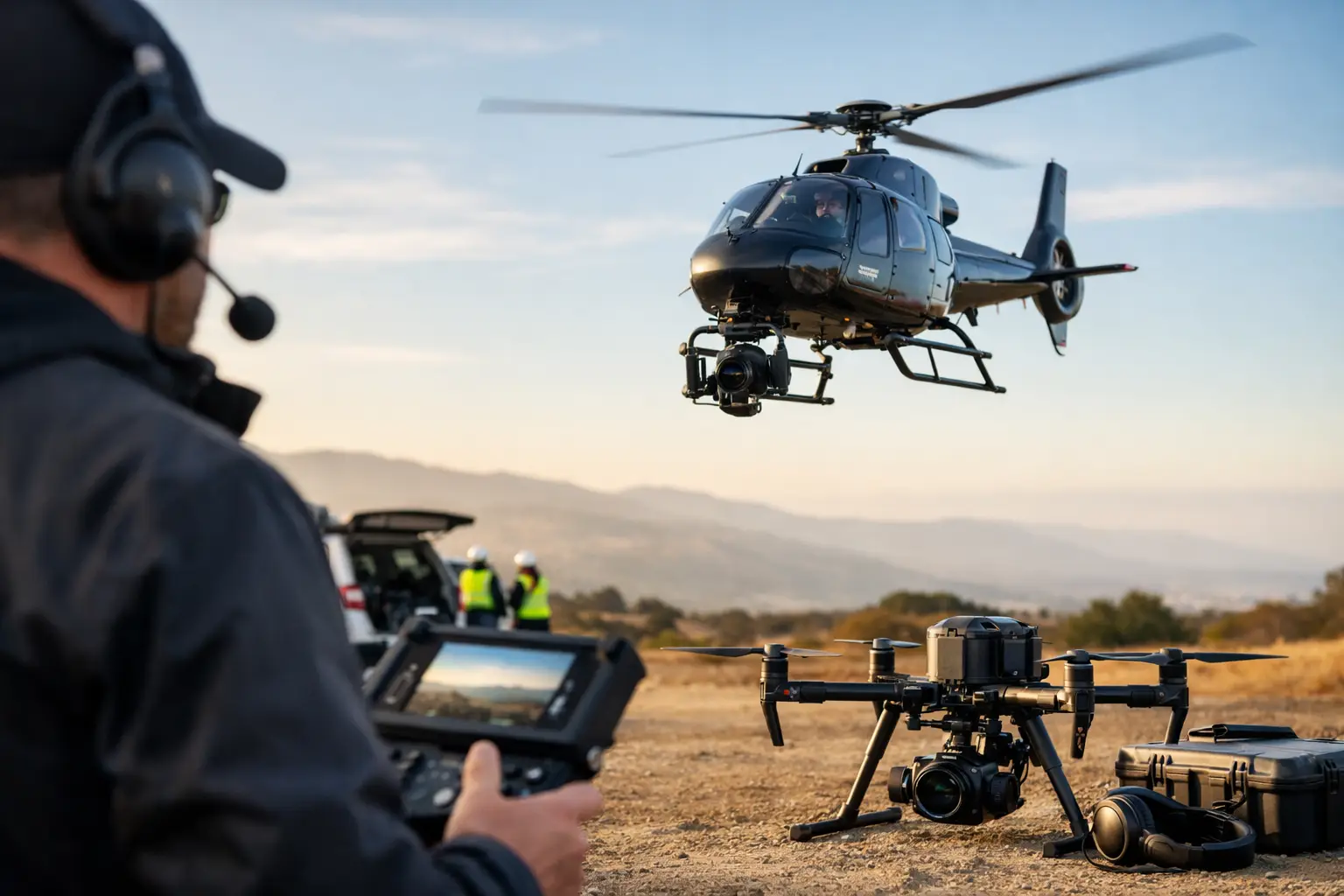
The camera system matters as much as the aircraft. Some productions use stabilized externally mounted camera systems, while others work with an approved handheld or cabin-based configuration. Each approach involves trade-offs. A stabilized mount can provide highly controlled imagery and reduce vibration, but it may require more planning, specialized equipment, and compatible aircraft. A cabin-based setup may be more practical for certain assignments, though the available angle, window configuration, and camera movement can be more limited.
Weight and balance are also central to planning. Camera equipment, mounts, operators, safety equipment, passengers, and fuel all affect the aircraft’s approved loading limits. The flight crew calculates these factors before departure and may adjust passenger count, equipment selection, or fuel stops accordingly. This is not administrative detail. It directly affects aircraft performance, especially in warm conditions or at higher elevations.
The pre-flight planning that protects the production
Aerial filming is rarely a matter of taking off and deciding where to go later. Before the aircraft departs, the crew should have a clear operational plan, including the filming area, route, altitudes, sequence of shots, communication method, and alternate options if conditions change.
For productions working from remote locations, ground coordination is especially valuable. The director, assistant director, location manager, vehicle drivers, boat captains, and security personnel should understand the planned aircraft arrival, the shot sequence, and the boundaries of the filming area. If a vehicle must enter a curve at a particular moment or talent must be in position on a beach, the timing needs to be coordinated safely from the ground.
Aerial operations also require appropriate permissions and compliance with applicable aviation rules. Depending on the mission, this can involve coordination related to airspace, airports, private landing locations, or filming areas. Productions may also need separate location permissions from property owners, venue managers, municipalities, conservation authorities, or other responsible parties. Aviation approval does not automatically grant access to film over or from every location.
At Aerotour, specialized aerial work is approached with the same safety-first discipline that supports private charter operations. Experienced crews, mission planning, and operational coordination help align a production’s visual objectives with the practical realities of flying in Costa Rica.
Communication in the aircraft and on the ground
Clear communication keeps the mission efficient and reduces unnecessary flight time. Before boarding, the pilot and camera team review seating positions, safety equipment, entry and exit procedures, equipment handling, sterile-flight expectations, and the method for requesting a pass, orbit, reposition, or return to base.
The camera operator should be able to describe requests in concise, aviation-aware terms. Rather than giving broad instructions such as “go closer” or “make it more dramatic,” a productive request might specify a direction, pace, or framing need: a slower left orbit, a wider pass, a parallel track, or a repeat from a defined landmark. The pilot evaluates each request against terrain, weather, aircraft limitations, airspace, and safe separation.
On larger productions, a dedicated aerial coordinator can help translate creative language into a sequence the crew can execute. This role is particularly useful when several moving elements are involved, such as picture vehicles, boats, talent, multiple cameras, or a ground unit operating on a narrow schedule.
Weather and light are operational decisions
Costa Rica’s light can be extraordinary, but weather can change quickly. Morning conditions may provide clearer visibility and calmer air in some regions, while afternoon convective weather can bring cloud buildup, rain, wind, or reduced visibility. Conditions vary by coast, elevation, and season, so a production should avoid assuming that a forecast for San José represents the conditions near a distant beach, mountain ridge, or rainforest location.
Weather affects more than whether the aircraft can fly. It changes the quality of the footage. Haze can soften distant landscapes. Wind can influence aircraft movement and the appearance of water or vegetation. Clouds can create dramatic contrast, but they can also interrupt continuity between takes. The most adaptable productions identify a primary window, a backup window, and alternate shots that can work under different light.
There is a practical balance between pursuing ideal conditions and protecting the schedule. Waiting for a perfect sky can consume a valuable flight window. Flying too quickly in marginal conditions can compromise safety or produce footage that does not match the intended look. An experienced operator and production team make those decisions together, based on current conditions rather than wishful thinking.
Safety boundaries that shape better footage
Professional aerial filming works within defined boundaries: approved operating procedures, aircraft limitations, required clearances, safe distances, and the pilot’s judgment. These boundaries are not obstacles to creativity. They encourage more disciplined planning, better location choices, and shots that can be repeated consistently.
The same applies to equipment and passenger behavior. Loose items, improperly secured cameras, distracting movement in the cabin, or last-minute changes to a flight plan can create avoidable risk. Production crews should arrive with equipment organized, batteries prepared, media cards ready, and a shot priority list that distinguishes essential footage from optional ideas.
It also helps to plan for the shot that cannot be repeated. If a specific sunrise, event, talent performance, or location access window is the central objective, schedule it early in the mission when fuel, crew attention, and weather options are strongest. Secondary scenic passes and exploratory footage can follow if conditions permit.
A well-run aerial filming flight gives the production more than impressive images. It gives the team confidence that every pass, adjustment, and creative decision is supported by experienced aviation judgment. When the flight plan respects both the camera and the aircraft, the result is footage with the freedom, scale, and precision that only an aerial perspective can deliver.