
Costa Rica Private Aviation Guide for Smart Travel


A well-planned private flight can turn a Costa Rica itinerary from a sequence of long road transfers into time spent at the destination. This Costa Rica private aviation guide is designed for travelers, executive teams, and production professionals who need to understand what private charter can realistically accomplish across the country – and what requires advance coordination.
Costa Rica is compact on a map but demanding on the ground. Mountain roads, changing weather, limited commercial schedules, and remote coastal or rainforest destinations can make a relatively short distance take several hours. Private aircraft and helicopters provide a practical alternative when time, privacy, direct access, or specialized flight support matters.
When Private Aviation Makes Sense in Costa Rica
Private aviation is most valuable when the schedule is the priority, not simply the flight itself. An executive arriving in San José for meetings and continuing to Guanacaste the same day has very different needs from a family connecting a Central Valley arrival with a remote resort. Both may benefit from charter, but the aircraft, routing, and timing should be planned around the actual mission.
For leisure travelers, charter can reduce the friction between major gateways and destinations such as the Papagayo Peninsula, the Nicoya Peninsula, Arenal, Manuel Antonio, the Osa Peninsula, or Tortuguero. Instead of building a trip around commercial flight timetables or extended driving times, guests can arrange a departure that works with their arrival, hotel check-in, or onward plans.
For corporate travelers, the appeal is control. A private flight can support site visits, multi-stop itineraries, confidential travel, or rapid regional movement without the constraints of airline schedules. Production teams and industrial clients may require something more technical: aerial filming, photography, survey support, or access to locations where ground logistics are slow and restrictive.
The right choice depends on passenger count, baggage, destination airstrip conditions, daylight, weather, and the degree of schedule flexibility available. Private aviation provides options, but it does not eliminate the operational realities of flying in a tropical, mountainous country.
Choosing Between a Private Airplane and Helicopter
Fixed-wing aircraft and helicopters solve different transportation challenges. Selecting the right platform begins with the route rather than the preference for one aircraft type over another.
Private airplane charter for longer regional transfers
A private airplane is often the practical choice for airport-to-airport travel, particularly when carrying several passengers and standard luggage. Costa Rica has domestic airfields that connect key tourism and business areas, allowing travelers to bypass lengthy road journeys. Fixed-wing charter is generally well suited to transfers between San José or Liberia and destinations with established runways.
Aircraft availability and capacity vary by mission. A group traveling with golf equipment, photography gear, multiple checked bags, or larger cases should discuss baggage requirements before confirming an aircraft. Weight and volume affect aircraft selection, especially on short runways or routes where weather and elevation influence performance.
A private airplane also works well for a multi-leg itinerary. For example, travelers may fly from San José to the Arenal area, continue to the Pacific coast, and later return through Liberia. This type of routing requires thoughtful planning, but it can preserve valuable time and create a more efficient trip than returning repeatedly to the same gateway.
Helicopter charter for direct access and aerial perspective
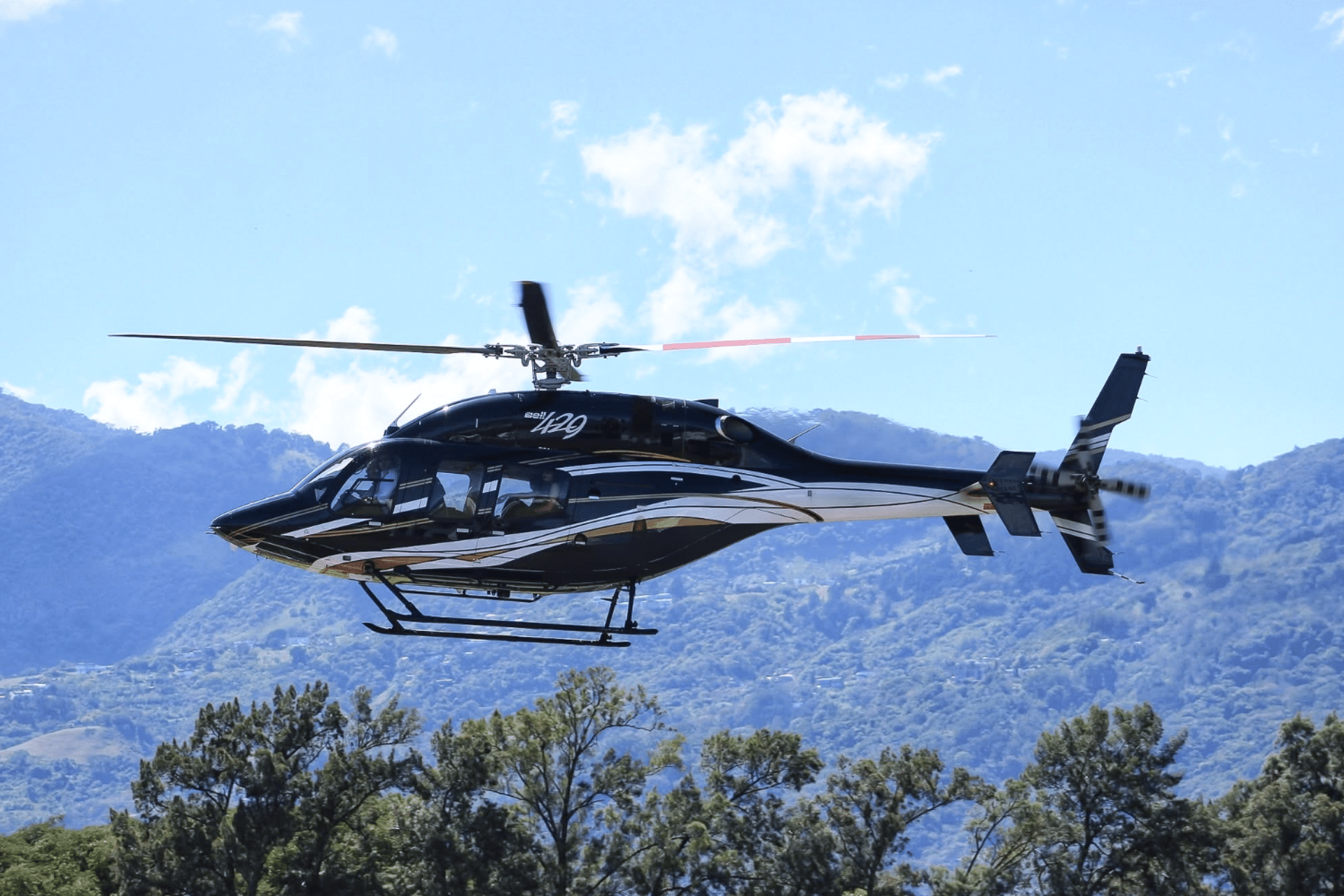
Helicopters offer a different advantage: the ability to reach approved landing locations that may be closer to a resort, private residence, event site, or remote work area than an airport runway. They are especially valuable for point-to-point transfers where a road journey is disproportionately long relative to the distance traveled.
They also provide an exceptional perspective on Costa Rica’s terrain. Volcanoes, rainforest, coastlines, waterfalls, and ridgelines are best understood from the air. A scenic flight can be designed as a dedicated experience or integrated into a transfer, provided route conditions, landing permissions, payload, and flight time support the plan.
The trade-off is cabin space. Helicopters have more defined baggage and passenger limitations than many travelers expect. Soft-sided luggage is often easier to accommodate than large hard-shell cases, and seating capacity must be evaluated alongside total payload. A clear manifest and baggage list help the operator recommend the appropriate aircraft from the start.
Airports, Airstrips, and Destination Access
San José and Liberia are the principal starting points for many private aviation itineraries. San José serves the Central Valley, business districts, and international arrivals on the country’s main population corridor. Liberia provides convenient access to northern Guanacaste, beach communities, resorts, and the Papagayo region.
From these bases, private charter can connect to domestic destinations with suitable airfields or approved helicopter landing areas. However, travelers should avoid assuming that every luxury property or remote destination has unrestricted aviation access. Some locations require prior authorization, have limited operating hours, or depend on local conditions.
Runway surface, length, terrain, and surrounding obstacles affect which aircraft can operate at a particular airfield. The same is true for helicopter landing sites, which require adequate dimensions, safe approaches, obstacle clearance, and permission to use the location. An experienced operator will evaluate these details before committing to a route rather than treating the destination as a simple pin on a map.
Ground transfer remains part of the equation. A charter flight may save hours overall, yet a resort could still be 30 to 60 minutes from the nearest airport. Coordinating vehicles, arrival timing, and luggage handling makes the experience more efficient from aircraft door to final destination.
Safety and Operating Standards Should Lead the Decision
A private flight should feel tailored, but its foundation must be disciplined aviation operations. Travelers and travel planners should ask about the operator’s certification, maintenance practices, pilot qualifications, dispatch procedures, insurance, and weather decision-making.
In Costa Rica, weather is not a minor planning detail. Conditions can vary dramatically between the Central Valley, Caribbean slope, Pacific coast, and mountain regions. Rain, cloud cover, wind, and reduced visibility may affect routing or departure timing, particularly during the green season. Responsible operators make conservative decisions when conditions call for them, even when a schedule is important.
That is why a flight quotation should not be the sole basis for selection. The lowest-priced option may not reflect the same standards of aircraft support, operational oversight, crew experience, or contingency planning. For travelers placing a premium on reliability, the operator’s ability to communicate clearly before and during the flight matters as much as the aircraft itself.
Aerotour brings operating experience dating to 1973, DGAC certification, and alignment with ICAO standards to private charter and specialized aerial missions. Those credentials matter because Costa Rica flying calls for local knowledge, technical judgment, and a consistent safety culture.
Planning a Private Charter: What to Provide Early
The strongest charter plans begin with precise information. A request should include preferred travel date, approximate departure window, number of passengers, ages of children if applicable, destination, baggage profile, and any special requirements. If there is a commercial flight connection, provide the airline, flight number, and scheduled arrival time so the charter team can plan a sensible buffer.
For executive and production travel, describe the mission rather than only the route. A team visiting several properties may need a same-day multi-stop schedule. A film crew may need doors-off or mission-configured aerial support, subject to safety procedures and aircraft suitability. A survey, construction, or industrial assignment may require equipment planning, flight permits, local coordination, and a defined operating window.
International visitors should also account for arrival procedures. A private domestic charter generally begins after passengers have completed immigration, customs, baggage collection, and the transfer to the domestic departure point. The exact sequence depends on the itinerary, but tight international-to-domestic connections should be discussed in advance rather than assumed.
Travel insurance, cancellation terms, weather contingencies, and transfer arrangements deserve the same attention as the flight itself. Premium service is not only about a private cabin. It is about having realistic expectations and a team prepared to manage the variables around the aircraft.
Timing Your Flight Around Costa Rica’s Conditions
Morning departures are often preferable for many domestic routes because weather can be more stable earlier in the day. This is not a guarantee, and each route has its own weather pattern, but it is a useful planning principle when an itinerary allows flexibility.
Daylight restrictions may also apply to certain operations and airfields. Travelers planning a sunset dinner arrival, a late resort check-in, or a final flight after an event should confirm the practical operating window before designing the day around it. A helicopter may offer different routing possibilities than a fixed-wing aircraft, but it is still subject to operational and weather limits.
Peak holiday periods should be arranged well ahead of time. Christmas and New Year, Easter week, major North American holiday windows, and high-season dates in Guanacaste can place pressure on aircraft availability, ground transportation, and destination services. Earlier planning usually offers more choice in aircraft and departure times.
A private flight is most effective when it supports the purpose of the trip, whether that means arriving rested for a board meeting, reaching a lodge before nightfall, or placing a production team in the right location while conditions are favorable. Share the full itinerary early, allow room for operational judgment, and let the aircraft serve the experience rather than dictate it.