
Best Costa Rica Scenic Flights: Routes Worth Taking

A road transfer from San José to a remote Pacific lodge can take most of a day. From the air, the same journey becomes part of the reason for traveling: coffee highlands give way to volcanic slopes, then rainforest, then a coastline cut by quiet coves. The best Costa Rica scenic flights are not simply about covering distance quickly. They offer a perspective on a country whose terrain is unusually dramatic and whose most rewarding destinations are often separated by mountains, rivers, or long stretches of coast.
For private travelers, the right flight depends on what they want to see, where they need to arrive, and how much flexibility matters. A helicopter may be the strongest choice for close-range visual access and distinctive landing possibilities. A private airplane may be more appropriate for longer regional transfers, groups, or airstrip-to-airstrip travel. Both can turn a necessary transfer into an exceptional part of the itinerary.
What Makes the Best Costa Rica Scenic Flights Different
Costa Rica is compact on a map but vertically complex in reality. The Central Volcanic Range, the Talamanca Mountains, dense forest canopies, river valleys, and two coastlines create changing views within a relatively short flight. The visual contrast is the advantage: a morning departure can include metropolitan San José, cloud forest ridges, and the Pacific in a single journey.
The most memorable flights are planned around a clear visual objective rather than a generic sightseeing loop. Some guests want the broad sweep of the Nicoya Peninsula and the Gulf of Nicoya. Others want a volcano-focused route, a low-altitude coastal approach where conditions permit, or a direct arrival near a secluded resort. Production teams may need stable aerial perspectives, carefully planned passes, and coordination around light, weather, and ground logistics.
That distinction matters because scenic flying is subject to operational realities. Weather, visibility, winds, airspace restrictions, approved routes, and landing-site conditions all affect what can be flown safely on a particular day. A premium operator should set expectations clearly, recommend the appropriate aircraft, and adjust the plan when conditions call for it.
Routes That Show Costa Rica at Its Most Dramatic
San José, Arenal, and the Northern Plains
A route connecting the Central Valley with Arenal offers one of the country’s clearest demonstrations of changing geography. Departing San José, passengers may see urban development framed by green mountains before the landscape opens toward agricultural land, forest, and the volcanic region near La Fortuna.
This is especially compelling for travelers who are combining the capital region with Arenal-area resorts. The value is practical as well as visual: instead of devoting hours to a winding overland journey, guests can arrive with more time for hot springs, private excursions, or a relaxed afternoon at the property. Conditions around volcanoes can change quickly, so early departures often provide the best chance of clear views, without guaranteeing them.
The Nicoya Peninsula and Pacific Coast
The Pacific is a natural fit for a scenic helicopter flight. From the air, the coastline reveals a geography that roads conceal: headlands separating beach towns, mangrove estuaries, islands in the gulf, and long arcs of sand beneath dry tropical forest.
Flights toward Tamarindo, Nosara, Santa Teresa, or the Papagayo region work particularly well when the goal is both access and a coastal experience. For a family or small private group, a charter can remove the friction of a long transfer while preserving privacy and control over departure timing. The trade-off is that coastal weather and afternoon heat can affect ride quality and visibility, making morning flights attractive when schedules allow.
Manuel Antonio, Osa, and the Southern Pacific
Costa Rica’s Southern Pacific feels more remote from the air because it is. The flight south can reveal rugged coastline, isolated beaches, rainforest-covered hills, and waterways that lead into the Golfo Dulce region. It is a powerful route for guests headed to luxury wilderness lodges, yachts, conservation-focused stays, or private villas.
Manuel Antonio provides a recognizable coastal landmark, while the Osa Peninsula offers some of the country’s most intact rainforest landscapes. This route is ideal for travelers who value time as highly as scenery. Overland access can be lengthy, and the aerial approach gives the arrival a sense of place before guests reach the ground.
The Caribbean Coast and Tortuguero
The Caribbean side delivers a different visual language. The terrain becomes flatter, greener, and wetter, with dense jungle, rivers, canals, and the broad horizon of the Caribbean Sea. Aerial transfers toward Tortuguero can be especially appealing because the destination’s water-based and remote character is apparent long before arrival.
This is not a route to choose solely for postcard views. It is a strong option when the itinerary includes lodge logistics, private schedules, or a desire to avoid long road and boat connections. Rainfall patterns can be highly localized on the Caribbean side, so dispatch planning and real-time weather judgment are central to a successful flight.
Helicopter or Private Airplane?
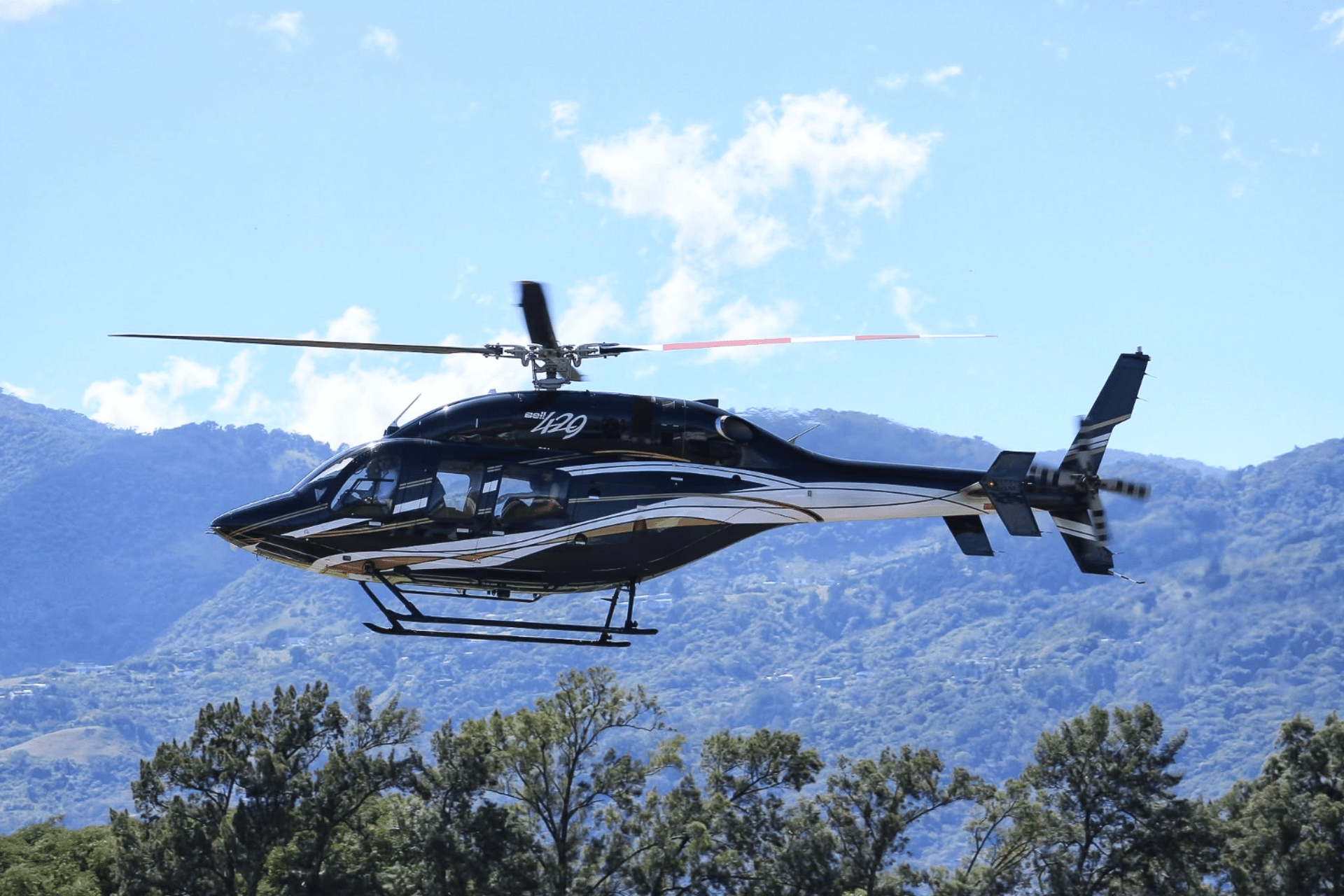
A helicopter is often the more immersive option for a dedicated scenic experience. Its wide viewing angles, ability to follow approved visual corridors at lower altitudes where appropriate, and access to selected helipads can make the flight feel closely connected to the landscape. It is particularly well suited to short custom excursions, coastal viewing, resort transfers, and aerial filming missions.
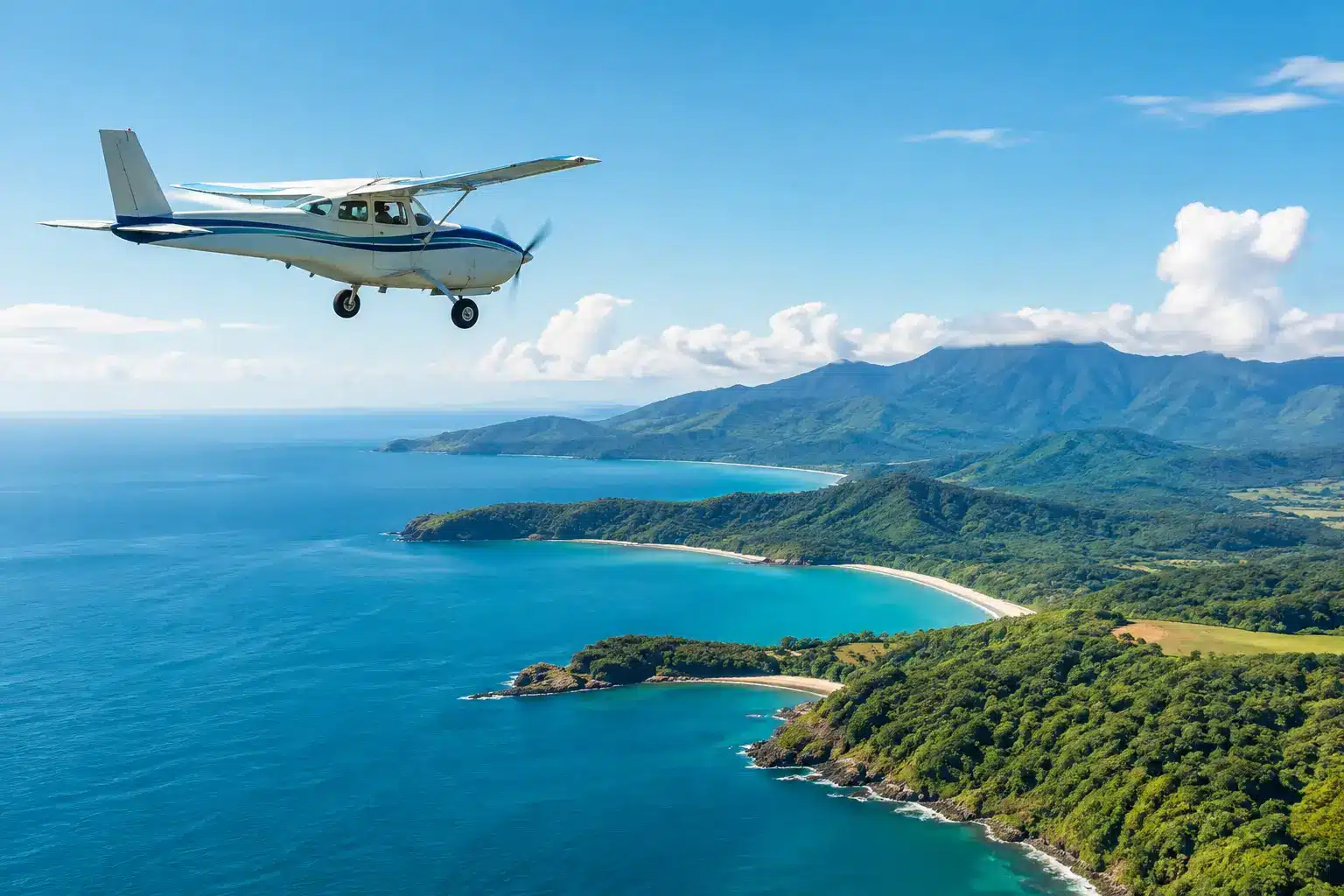
A private airplane generally makes more sense for longer distances, larger parties, or itineraries built around established airstrips. The perspective is broader and the cruise altitude may be higher, but the aircraft can be a highly efficient way to connect San José or Liberia with destinations across the country. For many guests, the best arrangement is not choosing one over the other in the abstract. It is matching the aircraft to the route, passenger count, baggage requirements, and desired arrival point.
Para aerial photography and film production, the decision requires an additional layer of planning. Camera configuration, door-off or open-door operating requirements where approved, communication systems, safety procedures, aircraft positioning, and light direction should be discussed before flight day. A scenic flight can produce remarkable footage, but production work should never be treated as an ordinary sightseeing charter with cameras added at the last minute.
Timing, Weather, and Comfort
Costa Rica rewards travelers who plan flights early in the day. Mornings often offer calmer air and clearer conditions, especially in mountainous areas where cloud development can build later. During the green season, rain may arrive in the afternoon, though regional patterns vary substantially between the Pacific, Central Valley, Northern Plains, and Caribbean.
The best advice is to build flexibility into a high-value itinerary. Schedule a scenic transfer or tour early when possible, avoid placing a nonrefundable commitment immediately after the flight, and listen to the operator if a timing adjustment is recommended. Safety-driven aviation decisions can feel inconvenient in the moment, but they protect the experience and the people on board.
Passengers should also consider comfort in practical terms. Wear light layers, keep loose items secure, use sunglasses that fit well, and confirm baggage limitations in advance. For guests sensitive to motion, a morning departure and a light meal beforehand can make a noticeable difference.
Choosing a Private Flight Partner
For scenic charter, aircraft appearance and destination photography should not be the only deciding factors. Ask about the operator’s certification, operating history, pilot experience, maintenance standards, dispatch process, and familiarity with the intended route. In Costa Rica, Certificación DGAC and adherence to ICAO standards are meaningful indicators of an operator built around aviation discipline rather than only tourism sales.
Aerotour brings experience dating to 1973 and operating bases in San José and Liberia, which is particularly useful for travelers planning custom helicopter or airplane itineraries across the country. The right conversation begins with the itinerary itself: travel dates, number of passengers, baggage, desired views, preferred departure point, and any special requirements for privacy, executive travel, or production support.
A well-planned flight should feel effortless to the passenger, but that ease comes from careful work behind the scenes. When the route, aircraft, weather window, and ground arrangements align, a scenic flight becomes more than a transfer or a tour. It becomes the moment Costa Rica’s scale, texture, and extraordinary geography finally make complete sense.