
Las 7 mejores rutas de tours en helicóptero en Costa Rica

Choosing among the best helicopter tour routes in Costa Rica is less about finding a single “top” flight and more about matching the route to what you want from the experience. Some travelers want dramatic coastline and resort access. Others want volcanoes, rainforests, waterfalls, or a fast, high-impact overview of the country’s varied terrain. When the aircraft, route design, and operating standards align, a helicopter tour becomes more than sightseeing – it becomes the most efficient way to understand Costa Rica’s geography in a single flight.
For premium travelers, families, executives, and production teams, route choice matters because every minute in the air has value. The right flight path should deliver clear visual contrast, good pacing, and access to places that are difficult to appreciate fully from the ground. It should also reflect practical considerations like weather patterns, transfer times, and whether the goal is leisure, scouting, or aerial filming.
What makes the best helicopter tour routes worth booking
The strongest routes share a few traits. First, they offer visual variety within a relatively short flight window. A route that moves from urban valley to volcanic terrain, or from dry tropical forest to open Pacific coastline, tends to feel richer than one that shows the same landscape for the entire journey.
Second, the best routes make sense operationally. In Costa Rica, weather can shift quickly, especially around mountainous regions and coastal zones in the rainy season. A well-planned helicopter tour route is not just scenic. It is realistic, efficient, and adaptable to actual flying conditions.
Third, premium travelers usually value perspective as much as excitement. Smooth routing, excellent visibility, professional flight planning, and experienced crews often matter more than simply adding flight time. A shorter route with iconic features and clean logistics may deliver a better experience than a longer route with less contrast.
Best helicopter tour routes for different travel goals
Arenal Volcano and northern rainforest
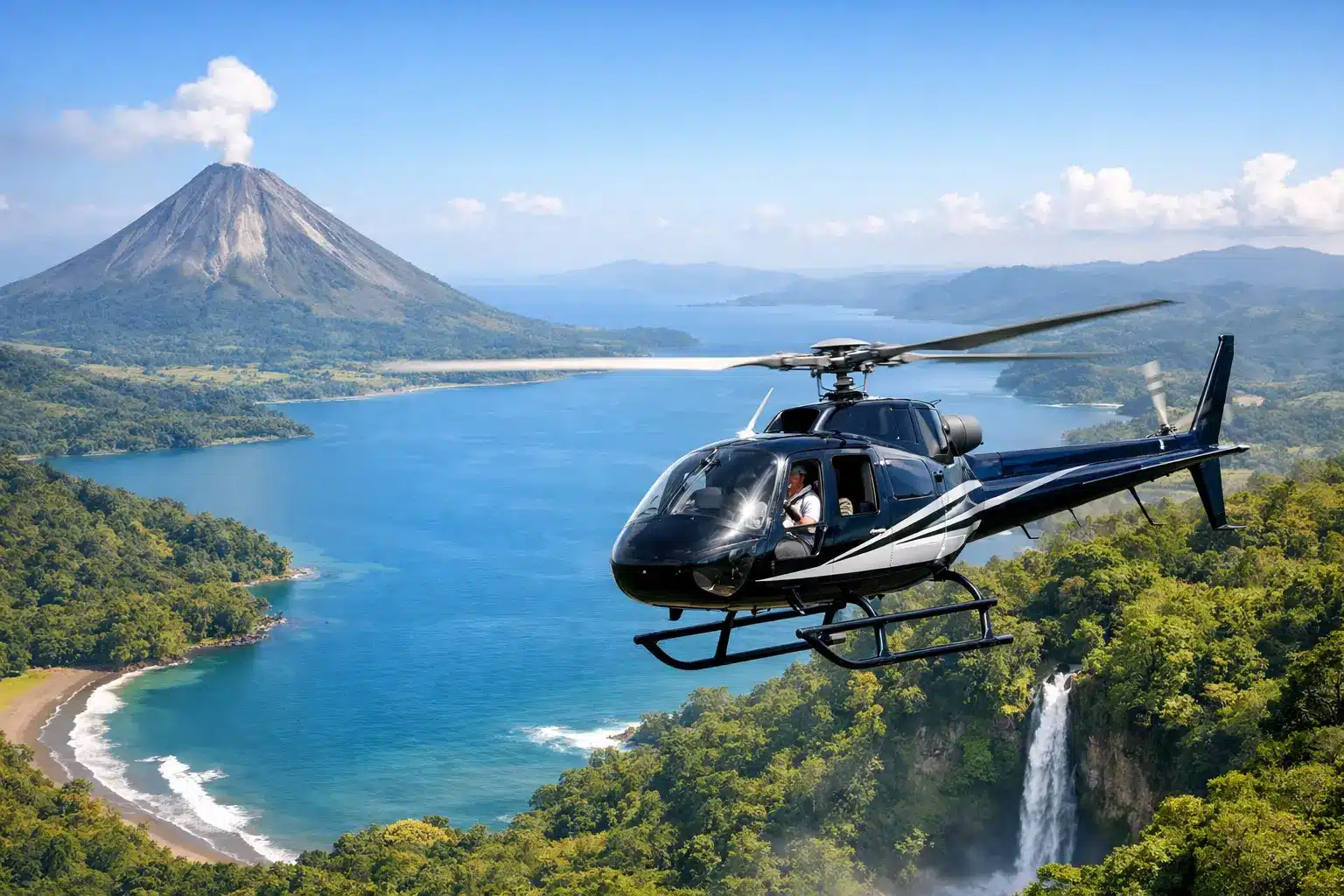
If your priority is classic Costa Rica scenery, Arenal is one of the strongest options. From the air, the volcano’s symmetrical form, the surrounding rainforest, and the shifting texture of the lake and foothills create a route with immediate visual impact. It works especially well for first-time visitors who want a recognizable natural landmark without sacrificing broader landscape variety.
This route is also a good fit for guests staying in the Central Valley or combining sightseeing with a transfer toward northern resorts. The trade-off is that conditions around volcanic and mountainous terrain can be more sensitive to weather than lower-altitude coastal flights. On a clear day, though, few routes feel more distinctly Costa Rican.
Pacific coast: Herradura, Jaco, and Manuel Antonio
For travelers who want coastline, marinas, cliffs, beaches, and resort zones in one flight, the central Pacific corridor is a leading choice. The stretch from Herradura and Jaco down toward Manuel Antonio gives passengers a strong mix of developed shoreline, protected forest, and open water views. It tends to feel dynamic from start to finish.
This is one of the best helicopter tour routes for visitors who want an upscale sightseeing experience tied closely to luxury accommodations and leisure destinations. It also suits groups with limited time because it delivers a lot of visual value without requiring a full-day commitment. Compared with inland mountain routes, it often feels more relaxed and accessible, especially for passengers new to helicopter flying.
Gulf of Papagayo and the Gold Coast
Northern Guanacaste offers a different kind of beauty. Instead of dense rainforest and steep green walls, this route shows dry tropical forest, sheltered bays, private villas, marina developments, and beaches with a more refined, resort-oriented character. The Gulf of Papagayo is especially attractive for travelers based in Liberia or luxury properties along the north Pacific coast.
The appeal here is not raw drama alone. It is the combination of elegant shoreline geography and efficient access. For couples, families, and second-home owners, this route often feels exclusive and polished. For executives or property-focused travelers, it can also serve a practical purpose by providing a fast regional overview.
Nicoya Peninsula and remote Pacific beaches
The Nicoya Peninsula is one of the best answers for travelers who want something less conventional. From the air, the peninsula reveals an appealing contrast between rugged coastline, surf beaches, estuaries, and pockets of low-density development. It feels more remote than the central Pacific and less manicured than Papagayo.
This route is ideal for passengers who already know Costa Rica and want to see a quieter side of the coast. It is also valuable for real estate scouting, hospitality site visits, or itinerary planning where road travel would take much longer. The trade-off is that the experience is more about breadth and coastal character than a single iconic landmark.
Central Valley to Poas and surrounding highlands
Not every helicopter route needs to be long to be memorable. A flight from the San Jose area toward Poas and the surrounding highlands can deliver a strong combination of convenience and scenery, especially for travelers with tight schedules. You get an immediate shift from urban infrastructure to agricultural land, cloud forest zones, and volcanic terrain.
This route works well for business travelers extending a short stay or visitors who want a premium aerial experience without committing to a half-day operation. It is also useful as an introduction to Costa Rica’s topographic diversity. The scenery is compelling, but the experience depends heavily on visibility, so timing and weather flexibility matter.
Waterfalls, rivers, and rainforest corridors
Some of the best helicopter tour routes are designed less around a famous destination and more around landscape texture. Flights that follow river systems, dense forest canopies, and waterfall zones can be especially rewarding for photographers and production teams. These routes create movement and visual rhythm, which often translates well both for personal enjoyment and for camera work.
This kind of custom routing benefits from working with an experienced operator that understands both scenic composition and flight safety. Not every area is equally suitable for every objective. A leisure passenger may want broad panoramas, while a filming crew may need stable passes, lighting considerations, and carefully coordinated turns.
Peninsula and island views for special occasions
For proposals, anniversaries, family celebrations, or VIP hosting, routes centered on dramatic shoreline and island perspectives tend to perform best. These flights are less about checking off landmarks and more about creating a refined experience with strong visual payoff. Open water, headlands, hidden beaches, and sunset-adjacent timing can make a relatively short route feel exceptional.
The key here is customization. The best route for a special occasion depends on where guests are staying, what time of day they prefer, and whether the goal is privacy, photography, or simply a memorable aerial perspective. Aerotour’s custom-flight approach is especially relevant in these cases because the experience depends as much on planning as on scenery.
How to choose among the best helicopter tour routes
The first question is simple: what do you want to see most clearly from the air? Volcanoes and inland terrain usually offer the strongest geological perspective. Coastlines tend to feel more open and relaxing. Rainforest routes can be spectacular, but they benefit from good light and visibility.
The second question is how the flight fits the rest of your itinerary. A helicopter tour can stand alone, or it can double as an efficient regional transfer. For high-value travelers, that combination often makes the experience more worthwhile. A scenic route that also reduces driving time has a different kind of value than a purely recreational flight.
The third factor is passenger profile. Families with children may prefer smoother coastal routing and moderate flight duration. Executives may want a route that pairs sightseeing with point-to-point access. Production teams may need doors-off considerations, communication planning, or route adjustments around light and terrain.
Timing, safety, and experience quality
The best helicopter tour routes are only as good as the operation behind them. Aircraft condition, pilot experience, route planning, weather judgment, and regulatory compliance shape the experience just as much as the landscape below. In a market like Costa Rica, where terrain and microclimates change quickly, seasoned operational decision-making is not a detail. It is central to both safety and quality.
Morning flights often provide cleaner visibility and calmer conditions, although this varies by region and season. Afternoon lighting can be beautiful along the coast, but cloud buildup inland may affect flexibility. This is why premium operators plan around real conditions rather than fixed sightseeing scripts.
A strong tour should feel effortless to the passenger, even though considerable planning happens behind the scenes. That includes weight and balance, routing efficiency, communication, and contingencies. For discerning travelers, confidence in the operator is part of the luxury.
Costa Rica rewards aerial travel because its terrain changes fast and dramatically. The right route can show beaches, jungle, volcanic slopes, river valleys, and luxury enclaves in a single experience. If you choose with purpose – not just popularity – the flight becomes far more than a view. It becomes the smartest way to see the country on your terms.